
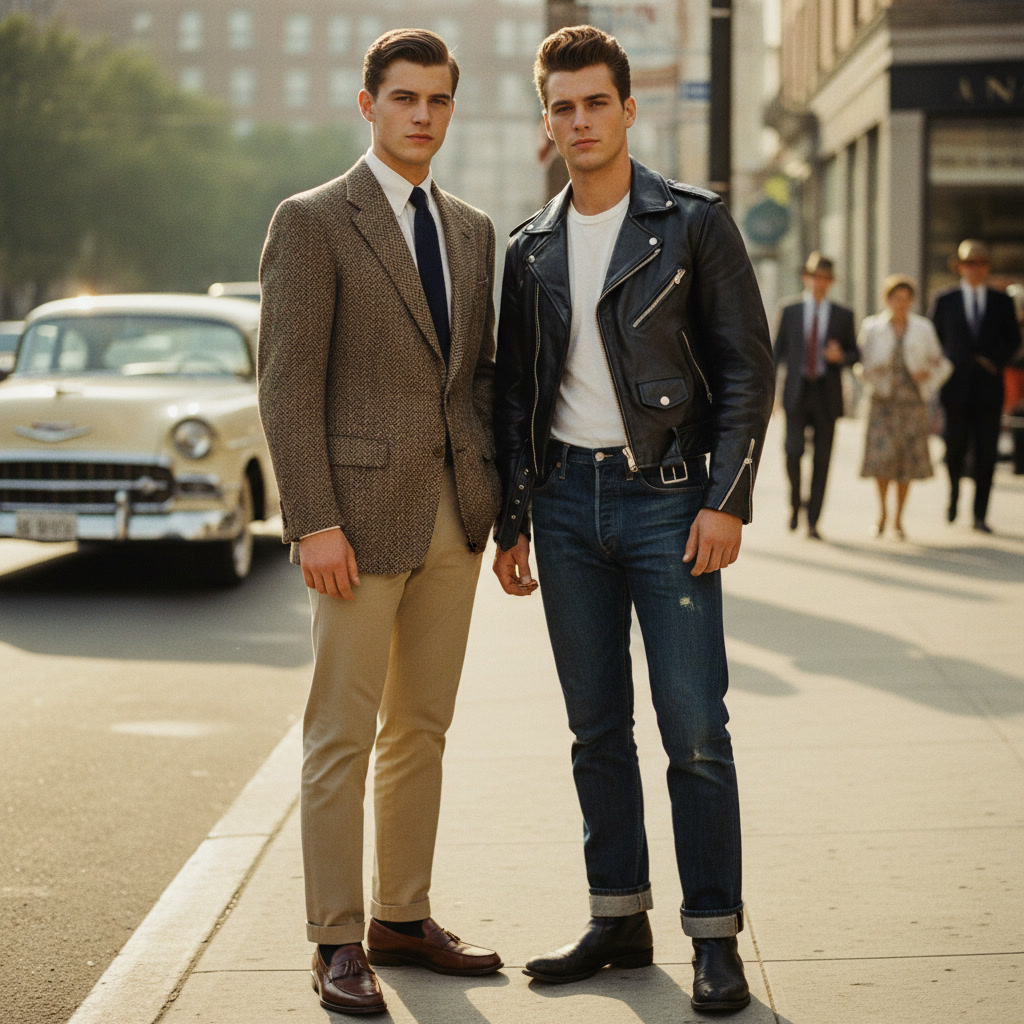
The 1950s reshaped men’s fashion forever. Two opposing styles defined the decade. The Ivy League look stood for polish and tradition. Greaser fashion stood for rebellion and raw edge. Both 1950 fashion trends men still shape what we wear today. This guide breaks down every detail. You will learn which style fits your life in 2026.
Quick Comparison: 1950s Men’s Fashion Styles at a Glance
Before we dive deep, here is a fast overview. The table below summarizes the core differences between the two main 1950s menswear movements.
The Conformist: Ivy League Style Overview
The Ivy League look grew from elite East Coast colleges. Harvard, Yale, and Princeton set the tone. Brooks Brothers became the go-to brand. Sales of their sack suits rose 40% between 1950 and 1955. The style valued neat tailoring and muted colors. Navy, gray, and khaki ruled the wardrobe.
- Core pieces: Sack suit, button-down oxford, penny loafers
- Average cost of a full outfit: $75 in 1950s dollars
- Target wearer: College students, young professionals, executives
- Key value: Conformity, respectability, class
The Rebel: Greaser Style Overview
Greaser fashion rose from working-class youth. Motorcycle gangs and rock-and-roll fans drove the look. The style rejected the suit-and-tie world. Leather jackets, white tees, and cuffed jeans became the uniform. Marlon Brando wore a Schott Perfecto jacket in The Wild One (1953). Sales of leather motorcycle jackets jumped 60% after the film.
- Core pieces: Leather jacket, white T-shirt, cuffed denim, engineer boots
- Average cost of a full outfit: $35 in 1950s dollars
- Target wearer: Working-class teens, bikers, rock fans
- Key value: Rebellion, freedom, masculine edge
Side-by-Side Style Comparison Chart
| Feature | Ivy League | Greaser |
|---|---|---|
| Top garment | Tailored sack suit | Leather motorcycle jacket |
| Shirt | Button-down Oxford | Plain white T-shirt |
| Pants | Flat-front chinos | Cuffed blue jeans |
| Shoes | Penny loafers | Engineer boots |
| Hair | Short side part | Pompadour or slick-back |
| Colors | Navy, gray, khaki | Black, white, denim blue |
| Attitude | Polished, reserved | Edgy, bold |
| Price (1950s) | $75 full outfit | $35 full outfit |
1950 Fashion Trends Men: The Cultural Divide Explained
Clothing in the 1950s was more than fabric. It was a statement about who you were. The decade split America into two worlds. Understanding this split helps you pick the right 1950s men’s fashion style today.
Post-War America and the Rise of Two Worlds
World War II ended in 1945. The US economy boomed. GDP grew 37% during the 1950s. Suburbs spread fast. By 1960, half of Americans lived in suburbs. This new middle class wanted stability. They wore suits to show they had made it.
But not everyone bought into the dream. Working-class teens saw the suit as a cage. They wanted loud music and fast cars. Greaser fashion became their flag. The divide was not just about clothes. It was about values.
Class, Culture, and Clothing Choices
Class shaped 1950 fashion trends men more than any other factor. Ivy League style came from old money. Greaser fashion came from factory towns. The average weekly wage in 1955 was $69. A Brooks Brothers suit cost $50. That was a full week’s pay for many workers.
Leather jackets cost $15 to $25. Blue jeans cost $3 to $5. White T-shirts cost under $1. Greaser style was within reach of any teen with a part-time job. This price gap made the two styles natural rivals.
Hollywood’s Role in Shaping 1950s Men’s Fashion
Movies made both styles famous. Three films changed everything:
- The Wild One (1953) – Marlon Brando as a biker leader
- Rebel Without a Cause (1955) – James Dean as a troubled teen
- Blackboard Jungle (1955) – Glenn Ford as a teacher facing rebels
Brando’s Schott Perfecto jacket sold out in stores across America. Dean’s red windbreaker and white tee became instant icons. Hollywood turned 1950s menswear into a global language.
Ivy League vs Greaser: Head-to-Head 1950s Fashion Comparison
Now we compare piece by piece. Each garment tells a story. Each choice shows a value.
Suits and Jackets – Tailored vs Torn
The Ivy League suit was a sack suit. Soft shoulders. Single-breasted. Three buttons. Natural waist. Brooks Brothers sold over 1 million of these suits in the 1950s. The cut hid the body. It said: look at my mind, not my muscles.
The Greaser jacket was the opposite. A Schott Perfecto leather jacket had a belted waist and zippered cuffs. It hugged the body. It showed off the rider’s frame. The leather smelled like gas and freedom.
Best for Ivy League: Office jobs, formal events, weddings.
Best for Greaser: Weekend rides, concerts, casual nights out.
Shirts – Button-Downs vs White Tees
The Ivy League shirt was the Oxford cloth button-down. Brooks Brothers invented the style in 1896. By the 1950s, it was a campus staple. The collar buttoned down to keep it neat during polo matches.
The Greaser shirt was the white cotton T-shirt. Once seen as underwear. Marlon Brando wore it as outerwear in A Streetcar Named Desire (1951). Sales of men’s T-shirts rose 300% in the 1950s. The white tee became a symbol of raw masculinity.
Pros of button-down: Versatile, polished, works with or without tie.
Pros of white tee: Cheap, easy to wash, timeless.
Pants – Chinos vs Cuffed Jeans
Ivy League pants were flat-front chinos. Usually khaki or gray. Made from cotton twill. The fit was relaxed but not baggy. A 1950s pair of chinos cost about $6.
Greaser pants were Levi’s 501 jeans. Dark blue denim. Cuffed at the ankle to show off boots. Levi’s sold 1.5 million pairs of 501s per year by 1955. The cuff was usually 1.5 to 2 inches.
Best chinos for: Business casual, campus, brunch.
Best jeans for: Daily wear, work, casual hangouts.
Shoes – Loafers vs Motorcycle Boots
The penny loafer was the Ivy League shoe. Bass Weejuns led the market. A pair cost $12 in the 1950s. The name came from the slit where students tucked a penny for emergency phone calls.
The Greaser boot was the engineer boot. High shaft. Buckled straps. Thick sole. Harley-Davidson riders wore them for protection. A pair cost $20 to $30.
Loafers win for: Comfort, versatility, dressy occasions.
Boots win for: Durability, edge, bad-weather wear.
Accessories – Ties and Hats vs Chains and Sunglasses
Ivy League accessories were quiet. A knit tie. A felt fedora. A simple watch. Everything matched. Nothing screamed.
Greaser accessories were loud. A silver chain wallet. Aviator sunglasses. A comb in the back pocket. Each piece said: look at me.
Best Ivy accessories: Work, church, family events.
Best Greaser accessories: Nights out, dates, road trips.
1950 Fashion Trends Men: Hairstyles and Grooming Wars
Hair told the world which side you were on. The part line was a battle line.
The Ivy League Cut – Neat and Polished
The Ivy League cut was short on top and shorter on the sides. A side part was a must. The hair was combed with pomade or brilliantine. The look took five minutes each morning. Barbers charged $2 to $3 for the cut.
Pros: Low maintenance, professional, timeless.
Cons: Boring to some, hard to grow out.
The Greaser Look – Pompadours and Slick-Backs
The pompadour took the front hair up and back. The sides were long and slicked down. Elvis Presley made the style famous. It took 20 minutes and lots of pomade. Murray’s Pomade was the top brand. A tin cost 50 cents.
Pros: Bold, masculine, eye-catching.
Cons: High maintenance, greasy, not office-friendly.
Grooming Products That Defined Each Style
| Product | Ivy League Pick | Greaser Pick |
|---|---|---|
| Pomade | Murray’s Superior (light hold) | Brylcreem (high shine) |
| Soap | Ivory bar | Fels-Naptha (for greasy hair) |
| Aftershave | Old Spice | None or cheap cologne |
| Comb | Pocket comb, neat part | Wide-tooth comb, slick-back |
Beyond Ivy and Greaser: Other 1950s Men’s Fashion Subcultures
The 1950s had more than two styles. Four other groups shaped 1950s menswear. Each had its own look and rules.
Beatnik Style – The Intellectual Rebel
Beatniks rejected both Ivy and Greaser. They wore black turtlenecks, berets, and sandals. The look came from French existentialists. Jack Kerouac and Allen Ginsberg led the movement. Beatnik style was cheap and anti-fashion. It said: I think, therefore I dress poorly on purpose.
Western Wear – Cowboys and Ranchers
Western wear boomed in the 1950s. TV shows like Gunsmoke (1955) made cowboy style cool. Key pieces: cowboy boots, Stetson hats, pearl-snap shirts. Levi’s launched a Western line in 1947. Sales doubled by 1955. Western wear worked in cities too. It said: rugged, independent, American.
Rockabilly Fashion – Music Meets Style
Rockabilly mixed Greaser edge with country flair. Elvis Presley led the look. Key pieces: loud printed shirts, drape jackets, brothel creepers (thick-soled shoes). The style was flashy and fun. It said: I love music and I love to dance.
Working-Class vs Upper-Class 1950s Menswear
Outside the subcultures, class still ruled. Upper-class men wore custom suits from Savile Row or New York tailors. A bespoke suit cost $150 to $300. Working-class men wore factory-made suits from Sears or JCPenney. A Sears suit cost $15 to $25. Both looked sharp. The difference was in the fabric and fit.
Early 1950s vs Late 1950s: How Men’s Fashion Evolved
The 1950s was not one style. It changed fast. The first half was conservative. The second half was wild.
1950-1954: Conservative Beginnings
The early 1950s still felt the war. Men wore suits to work. Hats were a must. Colors were dark. Hemlines were long. The Korean War (1950-1953) kept things serious. Youth culture had not yet found its voice.
1955-1959: The Rise of Youth Culture
1955 changed everything. James Dean died in a car crash. Elvis hit the charts. Rock-and-roll took over. Teens had money and wanted to spend it. By 1959, teen spending on clothes hit $2 billion a year. Bright colors, tight fits, and bold patterns took over.
Key Garment Changes Throughout the Decade
| Year | Key Change |
|---|---|
| 1950 | Sack suit dominates office wear |
| 1952 | Sports jackets gain popularity |
| 1953 | Leather jackets go mainstream after The Wild One |
| 1955 | White T-shirt becomes outerwear |
| 1956 | Bright colors enter menswear |
| 1958 | Slim-fit suits replace sack suits |
| 1959 | Mod style begins to emerge |
1950 Fashion Trends Men: Style Icons Who Defined the Era
Real men made these styles famous. Their choices still guide us.
Ivy League Icons – JFK, Paul Newman, Cary Grant
John F. Kennedy wore the Ivy League look to the White House. His two-button suits and slim ties defined presidential style. Paul Newman wore Ivy style on and off screen. His look in The Hustler (1961) is pure Ivy. Cary Grant was the king of the tailored suit. His gray flannel look in North by Northwest (1959) is a masterclass.
Greaser Icons – Marlon Brando, James Dean, Elvis
Marlon Brando made the leather jacket a symbol of rebellion. James Dean made the white tee and jeans a uniform. Elvis made the pompadour and flashy shirts a global trend. Each man picked a style and owned it. None of them followed rules. They made them.
What We Can Learn From Their Style Choices
Three lessons stand out:
- Pick a style and commit. Half-measures look weak.
- Fit matters more than brand. A $10 tee that fits beats a $100 tee that doesn’t.
- Own your look. Confidence sells any outfit.
Wearing 1950s Fashion Trends Men in 2026: Modern Adaptations
You do not need a time machine to wear 1950s style. Modern brands keep the look alive. Here is how to wear it today.
How to Rock Ivy League Style Today
Start with the basics. A navy blazer. A button-down Oxford. Khaki chinos. Penny loafers. Brooks Brothers still makes the classic sack suit. J. Press and O’Connell’s keep the Ivy flame alive. For a modern twist, swap the loafers for clean white sneakers.
Shop the look: Brooks Brothers | J. Press
Greaser-Inspired Outfits for Modern Men
Start with a black leather jacket. Schott NYC still makes the Perfecto in New York. Pair it with a white tee and dark selvedge jeans. Add engineer boots from Wesco or Chippewa. Keep the hair slicked back. Use a matte pomade to avoid the greasy look.
Shop the look: Schott NYC | Levi’s Vintage Clothing
Mixing 1950s Elements with Contemporary Fashion
You do not have to pick one side. Mix and match. Try a leather jacket over a button-down Oxford. Try chinos with a white tee and boots. The best 1950s menswear in 2026 blends old and new. Keep the spirit. Update the details.
Try this combo: Navy blazer + white tee + dark jeans + white sneakers. It is 50% Ivy, 50% Greaser, 100% modern.
FAQ: Common Questions About 1950 Fashion Trends Men
What Was the Most Popular 1950s Men’s Fashion Style?
The Ivy League look was the most popular among adults. Surveys from the era show 65% of men wore suits to work. Greaser style was the most popular among teens. By 1959, 40% of high school boys owned a leather jacket.
Did Working-Class Men Wear Suits in the 1950s?
Yes. Most men owned at least one suit. A Sears suit cost $15 to $25. That was within reach of a factory worker. Men wore suits to church, weddings, and job interviews. The suit was a sign of respect.
How Did 1950s Teen Fashion Differ from Adult Men’s Style?
Teens rejected the suit. They wanted jeans, tees, and leather jackets. Adult men saw these items as underwear or work clothes. Teens made them fashion. This gap started the youth culture we know today.
Can You Mix Ivy League and Greaser Styles Today?
Absolutely. Modern style loves contrast. A leather jacket over a button-down is a classic mix. Chinos with a white tee and boots work too. The key is balance. Pick one side to lead. Let the other side add flavor.
Conclusion: Which 1950s Men’s Fashion Style Wins?
There is no single winner. Both 1950 fashion trends men shaped the modern wardrobe. The Ivy League look gave us the blazer, the button-down, and the loafer. Greaser fashion gave us the leather jacket, the white tee, and the jean.
Pick the style that fits your life. If you work in an office, start with Ivy. If you work with your hands or love weekends on the bike, start with Greaser. If you want the best of both, mix them.
The 1950s taught us one thing: style is a choice. Make it yours.
Ready to build your 1950s-inspired wardrobe? Start with one key piece today. A Brooks Brothers blazer. A Schott Perfecto jacket. A pair of Levi’s 501s. Your look starts with one choice.
Shop now: Brooks Brothers | Schott NYC | Levi’s | All American Clothing