
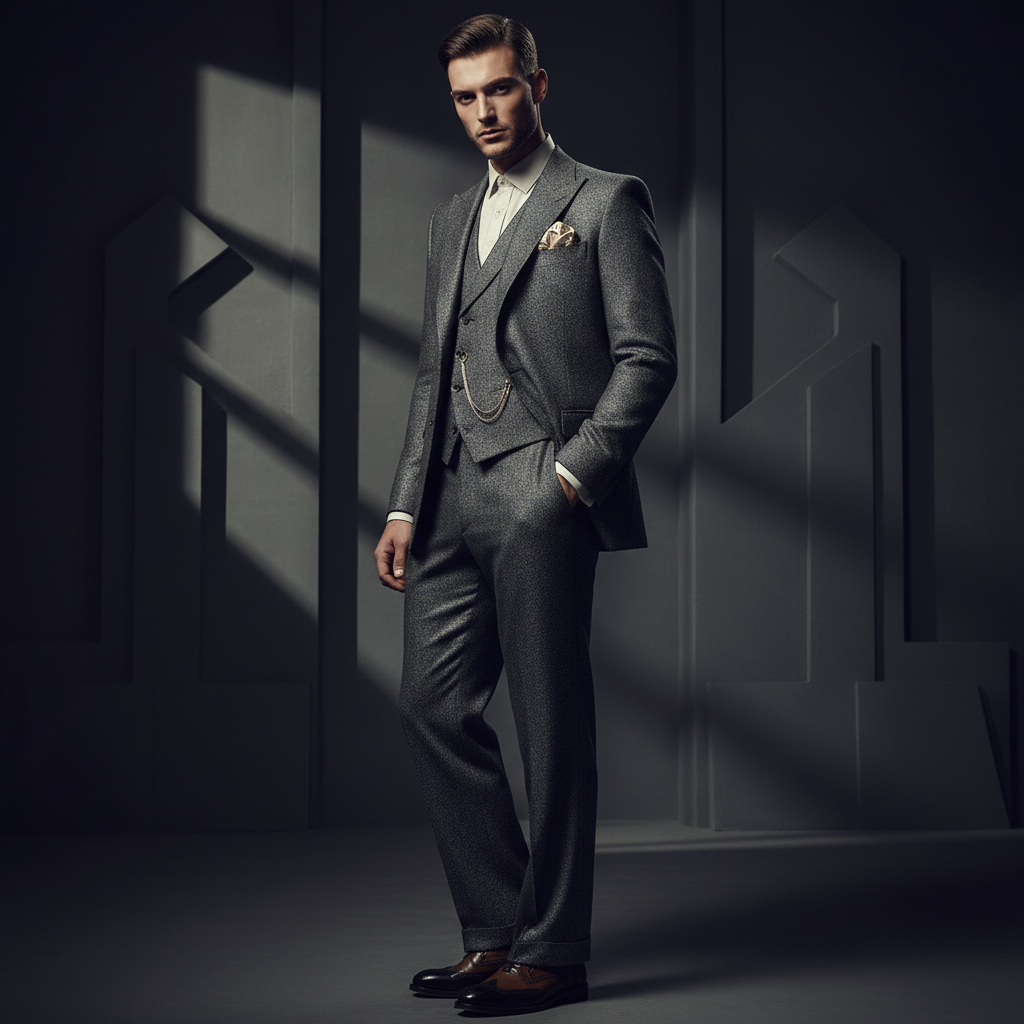
The 1920s reshaped how men dressed. World War I ended. Rigid Edwardian formality faded. A new era of self-expression began. 1920s mens fashion became bolder, more relaxed, and endlessly influential. This comprehensive evaluation examines every element of the era. We analyze fabrics, silhouettes, accessories, and cultural forces. You will understand why 1920s men’s style still matters today.
The Great Transition: From Edwardian Rigidity to Jazz Age Freedom
Before 1920, men wore stiff collars. They wore long tailcoats. Fashion followed strict rules. The Great War changed everything. Soldiers returned home. They wanted comfort. They rejected formality. 1920s mens fashion reflected this cultural shift. Men demanded clothing that moved with them.
The transition happened in two phases. From 1920 to 1925, jackets had extremely high waists. Lapels sat narrow and high. Trousers were relatively straight. After 1925, silhouettes relaxed further. Jackets dropped to normal waist height. Trousers widened dramatically. The famous Oxford Bags emerged. By 1929, 1920s mens fashion had its fully evolved look.
| Feature | Edwardian Era (pre-1920) | Early 1920s (1920-1925) | Mid-Late 1920s (1925-1929) |
|---|---|---|---|
| Jacket Length | Long, covering hips | Shortened, above hips | Short, natural waist |
| Waistline | Natural | Extremely high | Natural |
| Lapel Width | Moderate (2-2.5 inches) | Narrow (1.5 inches) | Wide (3-4 inches) |
| Trouser Leg | Straight, moderate | Narrow, cuffed | Very wide (22-24 inch cuff) |
| Collar | Stiff, detachable | Transitioning to soft | Soft, attached |
| Formality Level | Strict | Moderate | Relaxed |
This data shows a clear trajectory. 1920s mens fashion moved steadily toward comfort. It moved toward individual expression. These changes defined the decade.
The Three-Piece Suit: The Foundation of 1920s Mens Fashion
The suit dominated the decade. Most men wore a jacket, trousers, and waistcoat together. The three-piece suit was standard daywear for middle-class men. 1920s mens fashion treated the suit as essential. Even casual outings called for a suit jacket.
Suit Jacket Details
Jackets in the 1920s featured specific construction elements. Natural shoulders dominated. Padding was minimal. Jackets had two or three buttons. Single-breasted styles were most common. Double-breasted jackets gained popularity after 1925.
Key measurements defined the 1920s mens fashion silhouette. Jackets had a shorter cut than previous decades. The average jacket length measured 28 to 30 inches. Lapels grew progressively wider. By 1927, peaked lapels reached 3.5 to 4 inches. This width created the bold, commanding look that defined 1920s mens fashion.
Trouser Evolution
Trousers underwent dramatic changes during the decade. Early 1920s trousers were narrow and straight. They featured turn-ups or cuffs. The cuffs measured 1.5 to 2 inches. Trousers sat high on the waist. Suspenders held them up. Belt loops did not appear commonly until late in the decade.
After 1925, trousers widened considerably. Oxford Bags became the defining style. These trousers featured leg openings of 22 to 24 inches at the cuff. Some extreme versions reached 26 inches. The style originated at Oxford University. Students wore them over riding boots. 1920s mens fashion quickly adopted the look nationwide.
| Garment Element | 1920-1923 | 1924-1926 | 1927-1929 |
|---|---|---|---|
| Trouser Cuff Width | 1.5 inches | 2 inches | 4-6 inches (Oxford Bags) |
| Jacket Lapel Width | 1.5 inches | 2.5 inches | 3.5-4 inches |
| Jacket Button Stance | High waist | Mid-waist | Natural waist |
| Vest Prevalence | Standard (three-piece) | Common | Declining |
Fabric Choices in 1920s Mens Fashion
Wool dominated suit fabrics. British and American mills produced heavy worsted wools. Flannel became popular for winter wear. Tweed was the preferred choice for country and casual wear. Summer suits used lightweight linen and cotton blends.
Patterns distinguished 1920s mens fashion from earlier decades. Pinstripes gained immense popularity. Windowpane checks appeared frequently. Plaids and bold stripes were common. These patterns reflected the era’s enthusiasm for visual expression. A typical 1920s suit cost between $15 and $40. Adjusted for inflation, that equals $250 to $670 today.
Shirts, Collars, and Neckwear
Shirts in 1920s mens fashion came in specific styles. White remained the dominant color. Light blue and pastel stripes gained acceptance. All shirts featured long sleeves. Short sleeves appeared only for sportswear.
Collar styles evolved significantly. Detached stiff collars remained popular in the early 1920s. Club collars with rounded edges were fashionable. By mid-decade, soft attached collars became standard. This shift represented a major comfort improvement in 1920s mens fashion.
Ties added personality to 1920s mens fashion. Bow ties were standard evening wear. Four-in-hand ties dominated daytime. Ties featured bold patterns. Stripes, polka dots, and Art Deco geometric designs were popular. Silk was the preferred fabric. Tie widths averaged 2.5 to 3 inches.
Hats: The Essential Accessory in 1920s Mens Fashion
No outfit was complete without a hat. 1920s mens fashion treated headwear as mandatory. A man without a hat was improperly dressed. Several styles defined the decade.
- Fedora: The most popular hat of the 1920s. Soft felt with a pinched crown and brim measuring 2 to 2.5 inches. Worn tilted slightly. Made from fur felt or stiffened straw.
- Trilby: Similar to the fedora but with a shorter brim. More casual wear.
- Flat Cap: The working-class staple. Round, low profile. Made from tweed or cotton. Also popular with upper-class men for country wear.
- Straw Boater: The warm-weather essential. Flat-topped and stiff. Worn from May to September.
- Bowler: Declining in popularity but still worn by conservative men, particularly in Britain.
- Homburg: The formal daytime hat. Stiff felt brim with a center crease. Worn with morning dress.
Quality fedoras cost between $3 and $8 in the 1920s. Premium Stetson models reached $12. Today, quality reproduction fedoras range from $75 to $250. Hat etiquette in 1920s mens fashion was strict. Men removed hats indoors. They tipped hats to ladies. A man’s hat reflected his social status and personal style.
Footwear: Oxford Shoes and Beyond
Footwear in 1920s mens fashion followed specific conventions. Oxford shoes were the standard lace-up choice. They featured low heels and rounded toes. Two-tone spectator shoes became fashionable mid-decade. Black and white combinations were most popular.
Patent leather shoes were essential for evening wear. Black dominated formal occasions. Spats (cloth gaiters) covered the shoe tops and ankles. They protected shoes from street dirt. Spats came in white, grey, and black. They appeared in both button and zipper styles.
| Shoe Style | Occasion | 1920s Price | Modern Equivalent Price |
|---|---|---|---|
| Oxford Shoes | Daywear, business | $5-$12 | $120-$300 |
| Spectator Shoes | Casual, sporty | $7-$15 | $150-$350 |
| Patent Leather Pumps | Formal evening | $6-$14 | $180-$400 |
| Boots (Button) | Country, cold weather | $6-$10 | $200-$450 |
Sportswear and the Birth of Casual Wear
One of the most significant contributions to 1920s mens fashion was the rise of sportswear as a distinct clothing category. Before the 1920s, sport-specific clothing hardly existed. The post-war leisure boom changed this entirely.
Golf drove much of the innovation. Knickerbockers and plus-fours became associated with the sport. These were baggy breeches that fastened below the knee. They were worn with long argyle socks. Polo shirts, made of knitted cotton, emerged from the polo field. Tennis whites appeared on courts nationwide.
Cars influenced 1920s mens fashion significantly. As automobile ownership grew, men needed comfortable driving clothes. Leather coats, driving caps, and goggles became accessories. The sweater gained respectability as casual outerwear. Pullover sweaters in V-neck and crew neck styles paired with casual trousers. This casualization trend was revolutionary for 1920s mens fashion.
Swimwear Developments
1920s mens fashion saw revolutionary changes in swimwear. Previous decades used wool one-piece suits. The 1920s introduced shorter, more practical swimming trunks. Knitted wool remained the primary material. But the cut became more form-fitting. This era laid groundwork for modern swimwear design.
Class Distinctions in 1920s Mens Fashion
1920s mens fashion varied significantly by social class. Understanding these differences reveals the full picture of the era.
Middle-Class Fashion
Middle-class men drove the expansion of 1920s mens fashion. They invested in quality suits made from premium wool and linen. Department stores like Brooks Brothers and Montgomery Ward made fashionable clothing widely available. A middle-class man typically owned two to three suits. One for weekdays, one for Sundays, and perhaps a lighter summer suit.
The middle-class man wore a fedora. He wore Oxford shoes. He carried a handkerchief in his breast pocket. 1920s mens fashion for this class emphasized respectability and aspiration. Suits were well-tailored. Fabrics were durable. The investment in clothing signaled social position.
Working-Class Fashion
Working-class men adopted practical versions of 1920s mens fashion. Cotton and early synthetic blends replaced costly wool. Suits were simpler. Lapels were narrower. Waistcoats were often omitted. Flat caps replaced fedoras. Work boots replaced Oxford shoes for daily labor.
However, working-class men wore suits on Sundays and for special occasions. The suit remained aspirational across all classes. 1920s mens fashion showed a democratizing trend. Clothing became more accessible than in any previous decade. Mail-order catalogs brought current styles to rural areas.
Upper-Class Style
Wealthy men in the 1920s had the greatest range of clothing options. Bespoke tailoring from Savile Row or top American tailors remained the standard. The Prince of Wales, later Edward VIII, became a major style icon. His adoption of the Windsor knot, Oxford Bags, and plus-fours influenced global 1920s mens fashion. Raccoon fur coats became a status symbol among wealthy college students.
Art Deco and Its Influence on 1920s Mens Fashion
Art Deco shaped every aspect of 1920s culture. Its influence on 1920s mens fashion was profound. Geometric patterns appeared on ties, waistcoats, and shirt fabrics. Clean lines defined the silhouettes. The emphasis on modernity and machine-age aesthetics translated into structured clothing.
Art Deco brought boldness to 1920s mens fashion. Color mixing became acceptable. Contrasting patterns were combined. The movement celebrated progress and luxury. Evening wear reflected this most clearly. Dinner jackets in midnight blue appeared. Silk waistcoats in vibrant colors complemented simple black tuxedos. The 1920s mens fashion embrace of Art Deco gave the era its distinctive glamour.
Evening Wear in 1920s Mens Fashion
Formal evening wear maintained stricter rules throughout the decade. The tuxedo gained tremendous popularity. It replaced the tailcoat for most evening occasions. The tuxedo of the 1920s featured shawl collars or peak lapels. It was worn with a stiff-bosomed shirt. A black bow tie completed the look.
White tie remained the most formal dress code. Tailcoats were worn with white pique waistcoats. Wing-collar shirts with stiff fronts were mandatory. However, the tuxedo’s rise in the 1920s represented a permanent shift toward evening wear simplification. 1920s mens fashion evening rules relaxed significantly compared to previous generations.
Grooming and Personal Style
1920s mens fashion extended beyond clothing. Grooming standards were exacting. Hair was worn short and slicked back. Pomade was the essential styling product. Side parts were the norm. Clean-shaven faces were standard. Mustaches, particularly the pencil variety, were fashionable.
Perfume and cologne use increased dramatically. Men’s fragrances followed Art Deco aesthetics. Clean, fresh scents were preferred. The well-groomed gentleman was a central image of 1920s mens fashion. Personal presentation mattered enormously.
Modern Revival: Wearing 1920s Mens Fashion Today
Interest in 1920s mens fashion has grown substantially. Television shows like Peaky Blinders sparked renewed demand. The modern market offers multiple pathways to recreate or reference 1920s men’s style.
Where to Buy 1920s-Inspired Clothing
The market for 1920s mens fashion reproductions has matured considerably. Several quality brands now offer historically accurate pieces.
| Item Category | Recommended Brands/Retailers | Price Range | Quality Rating (1-10) |
|---|---|---|---|
| Three-Piece Suits | Bespoke Unit, Edgar & Brothers | $800-$2,500 | 8.5-9.5 |
| Fedora Hats | Borsalino, Christys’ London | $95-$350 | 8-9 |
| Oxford Shoes | Crockett & Jones, Grant Stone | $250-$600 | 8-9.5 |
| Suspenders | Albert Thurston | $65-$150 | 8-9 |
| Silk Ties | Drake’s, tiebar | $45-$195 | 7-9 |
| Tweed Jackets | Harris Tweed authorized makers | $350-$1,200 | 7.5-9 |
| Flat Caps | Billion Dollar Boy, Kangol | $30-$120 | 6.5-8 |
| Spectator Shoes | Barker, Meermin | $180-$500 | 7-8.5 |
Current shopping options for 1920s mens fashion include the following recommendations:
- Brooks Brothers – Classic American tailoring with 1920s heritage pieces. Quality suits starting at $598.
- Borsalino – Premium felt fedoras crafted since 1857 in the authentic 1920s style. Starting at $295.
- Albert Thurston – The world’s finest braces (suspenders). Authentic woven designs from $75.
- Crockett & Jones – Handcrafted English Oxford shoes in period-appropriate styles. Starting at $495.
- Suitsupply – Affordable modern suits with 1920s-inspired cuts. Three-piece sets from $449.
How to Incorporate 1920s Elements Into Modern Wardrobes
You do not need to wear a full period costume. 1920s mens fashion offers versatile elements for contemporary style. Consider these practical approaches:
- Start with accessories. A quality fedora or flat cap instantly references the era. Pair it with a modern overcoat. This approach works for daily wear.
- Adopt wide lapels. Modern suits with 3.5-inch lapels echo 1920s proportions. This single change transforms your silhouette toward Jazz Age aesthetics.
- Embrace patterns. Pinstripes, windowpane checks, and bold ties bring 1920s spirit to conservative modern outfits. A patterned waistcoat under a dark suit captures the era perfectly.
- Try spectator shoes. Two-tone shoes add vintage character to any outfit. They pair well with both suits and smart casual clothing.
- Add a pocket square. A white linen pocket square was universal in 1920s mens fashion. It remains one of the easiest style upgrades available.
Evaluation Summary: The Legacy of 1920s Mens Fashion
1920s mens fashion achieved something remarkable. It liberated men from Victorian constraints. It established the modern suit as we know it. It created categories of clothing we still use today. Sportswear, casual wear, weekend dressing, all emerged from this decade.
The data is clear. Lapel widths grew from 1.5 inches to 4 inches. Trousers expanded from narrow cuffs to 24-inch Oxford Bags. Collars softened. Colors brightened. Patterns became bolder. Every element of the wardrobe evolved toward freedom and expression. 1920s mens fashion was not merely about clothing. It was about a new way of living.
| Evaluation Category | 1920s Innovation Score (1-10) | Enduring Influence Score (1-10) |
|---|---|---|
| Silhouette Evolution | 9 | 8 |
| Fabric Variety | 8 | 9 |
| Casual Wear Introduction | 10 | 10 |
| Pattern Innovation | 9 | 7 |
| Accessory Development | 8 | 8 |
| Class Accessibility | 8 | 9 |
| Overall Impact | 9 | 9 |
1920s mens fashion scored 9 out of 10 for overall impact. Its innovations continue to influence designers. Its principles of comfort and expression remain relevant. Whether you seek a historically accurate reproduction or simply wish to borrow elements for modern style, 1920s men’s clothing offers endless inspiration.
Final Verdict: Should You Adopt 1920s Mens Fashion?
The answer is yes. 1920s mens fashion offers something for every man. The three-piece suit commands respect. The fedora adds character. Oxford shoes provide timeless elegance. Bold patterns express personality. The era’s emphasis on well-made clothing resonates in our age of fast fashion.
Start small. Buy a quality fedora. Invest in proper suspenders. Add a patterned tie to your rotation. Gradually incorporate wider lapels and higher waists. 1920s mens fashion does not demand full commitment. Even subtle references elevate your personal style. The Jazz Age called for individuality and courage. That spirit applies today just as much as it did a century ago.
Ready to embrace the elegance of the 1920s? Start building your vintage-inspired wardrobe today. Visit Suitsupply for modern suits with period character. Add Borsalino for headwear that commands attention. Complete your look with Crockett & Jones footwear. The 1920s called it dressing well. Today, we call it timeless style. Either way, 1920s mens fashion delivers results that last.